
Many people describe 2025 as a possible “darkest-hour rehearsal.”
That does not necessarily mean the world is heading straight into disaster. It means the coming period may become more complicated, more uncertain, and harder to predict than before.
In simple terms, the surface may still look calm, but deeper risks could already be building.
This article explains that idea in plain English. It breaks down the bigger global picture, China’s possible direction, and what ordinary individuals and families can do to stay prepared.
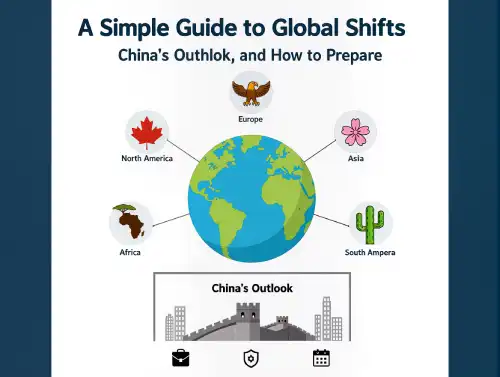
What does “2025’s darkest hour” really mean?
The phrase is not just about fear. It is more like a warning that the next stage of the world economy and global politics may involve several pressures happening at the same time.
These pressures may include:
- rising geopolitical tension
- prolonged regional conflicts
- uneven economic recovery
- bigger swings in financial markets
- more pressure on jobs, savings, and daily living costs
So when people talk about a “darkest hour,” they are often referring to a period of stress signals, not necessarily a single sudden collapse. It is about recognizing early warning signs before larger problems fully appear.
Why is the period before winter seen as important?
Some forecasts describe the period from early autumn to early winter as a preview stage.
The idea is that certain tensions may not fully explode right away, but warning signs begin to show more clearly.
In practical terms, this could mean:
- more visible friction between major powers
- deeper economic weakness starting to surface
- capital moving toward new regions
- global events gradually affecting ordinary households
The point is not mystery. The point is that serious periods are often not created by one event alone, but by many risks piling up together.
What could happen in the global landscape in 2025?
US-China tensions may continue to swing back and forth
It is difficult to describe US-China relations as simply “better” or “worse.”
A more realistic view is that both sides may cooperate in some areas while competing hard in others.
For ordinary people, this matters because it can influence:
- trade and supply chains
- technology sectors
- investment sentiment
- business confidence
- market volatility
This means global politics is no longer something distant. It can eventually affect jobs, prices, and investment decisions.
The Russia-Ukraine conflict may remain unresolved
Many people hope for a quick end to the conflict, but a longer and more exhausting standoff may be more likely.
That kind of situation affects:
- Europe’s recovery pace
- energy costs
- global supply stability
- investor confidence
For families and investors, this means global markets may remain sensitive and uncertain for longer than expected.
Europe may continue facing structural pressure
A simple way to describe Europe’s possible outlook is this:
recovery may be slow, and deeper structural challenges may remain.
That does not mean Europe has no opportunities, but it does suggest:
- weaker growth in some sectors
- higher living and operating costs
- more caution for investment and expansion
- more pressure on long-term planning
For those considering Europe for relocation, business, or investment, a more careful approach may be necessary.
Emerging markets may attract more attention
As the world becomes more multipolar, opportunity may not remain concentrated only in traditional power centers.
More attention may shift toward areas such as:
- Southeast Asia
- India
- Dubai and the Gulf region
- selected fast-growing regional markets
These places are often seen as attractive because of:
- growing populations
- rising demand
- flexible policy environments
- earlier-stage growth potential
This does not mean investors should rush in blindly. It means the future may offer more opportunities outside the old centers of power.
What could 2025 to 2027 mean for China?
Some analysts describe the period from 2025 to 2027 as a “knot.”
In plain language, that means a period where multiple issues become tied together and harder to untangle.
This could involve:
- old challenges not fully resolved
- new pressures starting to appear
- slower adjustment across markets and households
- greater need for patience and caution
That does not mean there will be no opportunities. It means this may not be the best period for aggressive expansion without strong risk control.
For ordinary people, the more practical focus may be:
- reducing unnecessary financial risk
- การปกป้องกระแสเงินสด
- simplifying expenses
- improving resilience
- keeping room for future opportunities
Why do people say cash matters most in uncertain times?
In unstable periods, cash flow creates safety.
Many people focus only on whether an asset can go up in value. But during a more difficult cycle, the real questions become:
- Do you have enough liquid cash for emergencies?
- Are your fixed expenses too high?
- Can your household handle income disruption?
- Are your investments too concentrated?
- Are you overexposed to one sector, one country, or one idea?
That is why the old saying still matters:
When you have enough in hand, your mind stays calm.
Practical ways to prepare for 2025
Build a stronger emergency fund
A practical target is six to twelve months of living expenses.
This gives you more breathing room if work, business, or markets suddenly become unstable.
Reduce fixed expenses
Now may be a good time to review:
- rent or mortgage commitments
- car payments
- subscriptions
- non-essential spending
- business overhead
In more uncertain years, durability matters more than appearance.
Avoid heavy leverage
Leverage can increase profits in good times, but it can also magnify losses very quickly in bad times.
That applies to business expansion, personal investing, and lifestyle spending.
Keep part of your assets liquid
If all your money is stuck in hard-to-sell assets, you may lose flexibility when you need it most.
In uncertain cycles, flexibility can be more valuable than chasing maximum returns.
What should families care about most?
Many people think global events are far away from daily life.
But eventually, those changes often show up at home.
They may affect:
- food and transport costs
- income stability
- housing decisions
- education spending
- investment returns
- stress levels inside the family
That is why a smart household plan should include:
- enough emergency savings
- realistic monthly budgeting
- diversified income sources if possible
- more balanced asset allocation
- less dependence on one fragile source of security
Prepared families do not panic less because the world is easy. They panic less because they planned earlier.
Should investors become more defensive?
Overall, this kind of period may favor a stability-first approach rather than a fast-profit mindset.
Why? Because uncertainty may come from several directions at once:
- geopolitical conflict
- interest rate shifts
- trade restrictions
- financial-market volatility
- regional instability
That means not every asset will follow old patterns.
A more careful investment approach may include:
- not putting all capital into one market
- avoiding emotional trading
- keeping cash for future opportunities
- spreading risk across different asset classes
- using clear entry and exit rules instead of chasing hype
In other words, planning may matter more than prediction.
Why is 2026 often described as even more sensitive?
Some people believe 2026 could become even more volatile because several themes may continue or intensify:
- war-related risks may remain unresolved
- trade disputes may continue
- financial markets may react more sharply
- regional tensions may spread
- global competition may become more obvious
If 2025 is the rehearsal, then 2026 could feel like a more intense phase of the same broader cycle.
That is why preparation today may matter more than last-minute reaction later.
The most realistic strategy for individuals
Protect yourself first
Whether you are an employee, entrepreneur, or investor, the first goal is not maximum profit. The first goal is staying strong enough to continue.
Simplify your life and finances
In uncertain periods, simple structures are often the most resilient.
The fewer unnecessary burdens you carry, the easier it is to adapt.
Keep your options open
Do not lock yourself into one city, one income source, one business path, or one investment bet if you can avoid it.
In the coming years, flexibility may be one of the most valuable forms of security.
Watch new opportunities, but move carefully
Emerging markets may offer growth, but that does not mean jumping in blindly.
A small-step approach often makes more sense than a full commitment too early.
Think beyond one year
The next two or three years may not be the easiest period, but they may also reshape where future opportunities come from.
Those who stay stable during the uncertainty may be in a stronger position later.
Final thoughts
The idea of a “darkest-hour rehearsal” is not really about predicting doom.
It is about understanding that the world may become more complex, more fragile, and more uneven.
In that kind of environment, the most valuable skills are not blind optimism or constant fear. They are:
- seeing risks early
- controlling exposure
- การปกป้องกระแสเงินสด
- managing household stability
- preparing for change before it arrives
No matter how the outside world shifts, one principle remains useful:
When you have enough in hand, you do not panic easily.