
What the “Suggested Action” Means (Buy / Hold / Sell)
Whisber turns each trend into a Buy / Hold / Sell Suggested Action so you know what to do right now without overthinking charts:
- Acheter = with-trend entry/add
- Prise = maintain, don’t chase
- Vendre = de-risk/exit (or short if that’s your playbook)
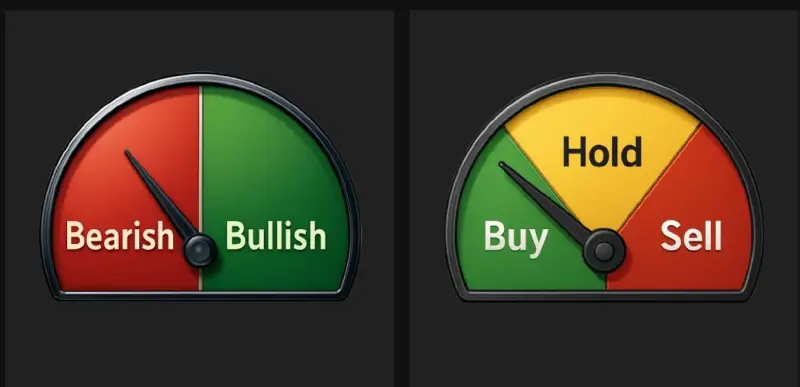
1) What Buy / Hold / Sell action actually tells you
🟢 Acheter
- Meaning: The system detects conditions that favor adding long exposure (with the prevailing trend).
- Typical context: Fresh green cluster on the heatmap, gauge points Bullish/Uptrend, short-term duration building.
- Your move: Enter or add small-to-standard size following your plan.
- Risk tip: Place stop below the latest swing low (for longs). Risk ≤ 1% of account on short-term trades (≤0.5% if new).
🟡 Prise
- Meaning: Trend is fine, but no edge to add right this second.
- Typical context: Price extended after a Buy, or mixed/neutral short-term while long-term stays bullish.
- Your move: Do nothing new. Manage what you already have—trail stops, take partial profits, wait for the next clean signal.
- Risk tip: Hold reduces FOMO. If you missed the entry, wait for a pullback or the next Buy—don’t chase.
🔴 Vendre
- Meaning: Conditions favor reducing or closing long exposure (or considering a short if you trade both ways).
- Typical context: Red cluster forms, gauge flips Bearish/Downtrend, or long-term turns against you.
- Your move: Exit partial or full per your plan; hedge if needed.
- Risk tip: Don’t argue with a Sell. Protect capital first; you can always re-enter on the next Buy.
2) Quick Buy / Hold / Sell decision table
| Dashboard reads… | If you’re flat | If you’re already long | If you’re short-enabled |
|---|---|---|---|
| Acheter | Start a position (starter size) | Consider top-up on pullback; trail stop | Avoid new shorts; cover weak ones |
| Prise | Wait; set alerts | Do nothing new; manage stops/TP | Stand by; only keep high-conviction shorts |
| Vendre | Stay flat | De-risk or close; hedge if needed | Consider short setups with smaller size |
3) “Buy / Hold / Sell” with Long-Term vs Short-Term
- Best quality trades: Acheter on court terme when Long-Term is Bullish.
- Protect mode: Vendre on court terme when Long-Term is Bearish.
- Mixed signals (LT Bullish, ST Sell): treat as pullback—size down or wait for ST to flip back to Buy.
- Neutral phases: you’ll see more Prise—that’s the system telling you to preserve energy.
4) Simple numeric example (plug & play)
Account: $1,000
Risk per trade: 1% = $10 max loss
Signal: Acheter at $50, stop at $49.50 → distance = $0.50
Position size: $10 ÷ $0.50 = 20 units
Profit plan:
- TP1: +0.8% → $50.40 (sell 50%)
- TP2: +1.8% → $50.90 (sell 80% of remainder)
- Runner: keep a tiny piece while the dashboard stays Buy/Hold; exit runner on Vendre
5) Do’s & Don’ts
Do
- Treat Acheter / Conserver / Vendre as your traffic lights.
- Use clusters, duration, et gauge together for confirmation.
- Pre-define risk (≤1%), stop location, et two-step take-profit.
Don’t
- Chase after a Prise—wait for the next Acheter or a pullback.
- Ignore a Vendre hoping it comes back. Rules > feelings.
- Size by “gut feel.” Use the Max loss ÷ Stop distance rule.
6) FAQ
Is “Buy” always right now?
Usually yes, but best entries often come on a small pullback shortly after. Use alerts and don’t chase vertical moves.
Why so many “Hold” signals?
Because most of the time the right move is to do nothing. Hold preserves gains and avoids FOMO entries.
Can “Sell” be a false alarm?
Any single flip can revert. That’s why we trust clusters/duration and follow our risk rules. Exiting is never a mistake—re-entries exist.